What Is a Consumer Confidence Report? A North Carolina Primer
A Consumer Confidence Report can be useful, but it is easy to mistake a system-wide summary for a test of the water at your own tap. North Carolina residents can use a CCR to understand what a community water system reports, where to find the document, and what questions it cannot answer about a particular home.
What a Consumer Confidence Report tells you
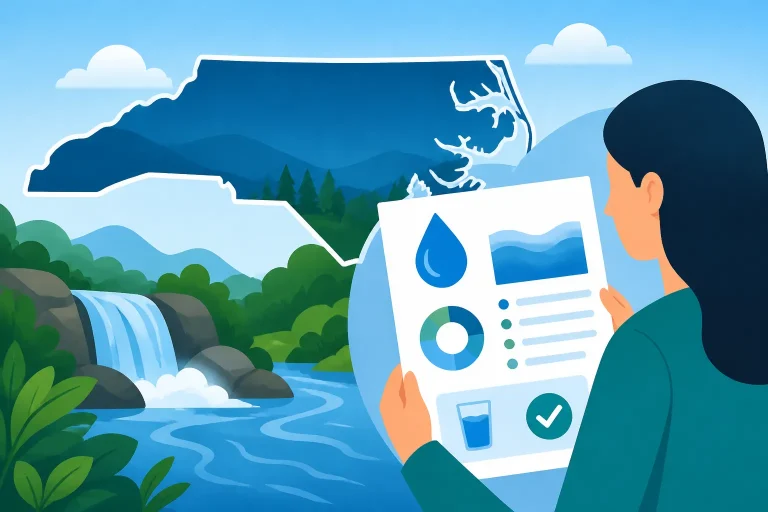
A Consumer Confidence Report, usually shortened to CCR, is a drinking-water quality report for customers of a community water system. According to Charlotte Water, the EPA requires community water systems to provide customers with a report containing detailed information about drinking water quality during the past year. According to the City of Raleigh, a CCR is published annually as required by the Safe Drinking Water Act and summarizes water quality data from the previous calendar year.
That timing matters. A CCR is a look back at water quality data for a defined reporting period, not a live reading of what is coming through your faucet at this moment. A system’s current conditions, its treatment processes, or the water inside your home’s plumbing may differ from what a past-year report can show.
For example, Charlotte Water describes its 2025 report as covering last year’s water quality. That illustrates the usual look-back format: the report is published after the data period it summarizes. When you open a CCR, check which year the report covers before interpreting its findings or comparing it with another document.
A CCR is designed to help customers understand information about the water system serving them. It can give you a starting point for questions about reported water quality, but it does not tell you everything about every tap, pipe, or treatment device in a home. It is best used as one piece of information alongside your water supplier’s current notices and, when needed, testing at the tap.
Keep these distinctions in mind:
- It describes a water system, not necessarily one home. The report relates to the supplier’s drinking-water data, rather than a separate inspection of every customer’s plumbing.
- It looks back at a reporting period. It is not automatically a real-time status update.
- It is not a substitute for a current advisory. If you are checking whether water is subject to a current notice, look for current information from your supplier.
- It is not a private-well test. If a home has a private well, a community system’s CCR does not describe that well’s water.
If you are unsure whether an address is served by a community system, start by identifying the supplier. How to Find Out Who Supplies the Water at Your North Carolina Address explains how to trace that connection. For a broader distinction between public supply and private sources, see What Counts as a Public Water Supply in North Carolina?.
Who the report is for and where to find it
The first question is not always “What does the report say?” It is “Is this the report for the water system that serves this address?” North Carolina has many different suppliers and system types. A nearby town’s report may not apply to a home outside its service area, and two neighboring properties can have different water arrangements.
If you receive a water bill, the name on the bill is a useful clue, but it may not tell the whole story. A property might receive water from a community system, a private water company, a shared system, or a private well. Some suppliers may purchase treated water from another system, so the name a customer sees and the source behind the water can be different. Confirm the supplier for the specific address rather than assuming that the nearest city or utility serves it.
The North Carolina Department of Environmental Quality page links to Consumer Confidence Reports. That can be a useful starting point when you know the system name but have not found its report. The water supplier’s official website is another place to check. Search for the supplier’s name and terms such as “water quality report” or “Consumer Confidence Report,” then confirm that the document names the correct system and reporting period.
If the report is difficult to locate, these steps can help:
- Check a recent water bill, account notice, or supplier communication for the service provider’s name.
- Confirm that the report refers to the system serving the property, not simply a nearby municipality.
- Look for the report’s coverage year and verify that it is the document you intended to read.
- If the supplier publishes more than one water-quality document, check the report title and description rather than assuming the documents cover the same information.
- If you still cannot find the right document, ask the supplier where customers can access its current CCR.
The article Can’t Find Your NC Utility’s Water Quality Report? How to Request It can help if a report is not readily available. If you are unsure what kind of system serves an address, City Utility, Community Well or Private Well? Sorting Out a NC Address may help you identify what to check next.
A report’s title can vary. It may be called a Consumer Confidence Report, a consumer water-quality report, or an annual water-quality report. A different label does not by itself prove that the document is a different kind of report. Check what period it covers, which system it describes, and how the supplier characterizes it. CCR vs. Annual Water Quality Report: Same Document in North Carolina? looks more closely at that naming question.
| What you need to know | What to check |
|---|---|
| Whether the report applies to your address | The supplier and system named in the report |
| What period the report covers | The reporting year or period described by the supplier |
| Whether there is a current water notice | The supplier’s current announcements, not only an older CCR |
| Whether the report describes a private well | A CCR for a community system does not test an individual private well |
| Where to look for a North Carolina report | The supplier’s official website and the North Carolina Department of Environmental Quality page |
How to read the report without getting lost
A CCR can look dense because it brings together water-quality information and explanations for customers. You do not have to read every paragraph in order to get oriented. Start with the introductory material, identify the system and reporting period, and then find the data and explanations that match your question.
Confirm the system and reporting period
Before interpreting any result, confirm that the report names the system that serves your property. Then check the period it summarizes. The City of Raleigh says its CCR summarizes water quality data from the previous calendar year. Other reports may present the period in their own introductory wording, so read the report’s description rather than assuming that publication date and data period are the same.
This is especially important if you find an older report through a search engine or a supplier’s archive. A document can be accurate for the period it covers and still not tell you whether a more recent notice or change applies. Use the CCR for historical context and the supplier’s current communications for current conditions.
Find the summary and the data
Many readers begin with a short overview before looking at detailed results. Use that overview to understand how the supplier describes its water and where the report directs customers for more detail. Then look for tables or sections that present water-quality data. The layout and terminology can differ, so follow the headings and any explanatory notes in the report itself.
Pay attention to the units and the time period attached to a result. A number without its unit, measurement context, or explanatory note can be misleading. If the report presents a range, average, or other summary, do not assume that it means every sample had that same value. The report’s notes should explain how to read its particular presentation.
To understand the terms in a results table, see MCL, Action Level, ND: Decoding the Terms in Your NC Water Report. That can help distinguish a reported detection, a limit, and a result that is described using an abbreviation. If a term remains unclear, use the definitions in the report and ask the supplier what the term means in that specific table.
Read the explanation with the result
A table is only part of the story. Read any notes beside it, the explanation of how the data were collected, and the supplier’s discussion of what the results mean. A result should not be treated as a standalone verdict without its context. In particular, note whether the report is presenting a system-level result, a sample result, or another kind of summary.
If a report uses terms that sound similar but have different meanings, do not substitute one for another. “Detected,” “not detected,” and “violation,” for example, do not mean the same thing. The report’s explanation should help you understand what it is saying and what it is not saying. For a deeper look at report wording, How to Read a North Carolina Water Quality Report is a useful companion.
Keep the report’s limits in view
The CCR describes information collected and reported for the water system and period it covers. It does not establish that a particular faucet was sampled, that every home has the same plumbing, or that water quality has remained unchanged since the report period. If you are trying to answer a home-specific question, note that distinction before deciding what to do next.
A practical first pass is to write down the supplier name, the covered period, the result or term you want to understand, and any question the report leaves open. That makes a follow-up conversation with the supplier more focused. It also helps prevent a common mistake: treating a document that answers a system-level question as if it were a test of an individual household.
What a result can and cannot tell you
A CCR can help you understand what the supplier reports about water quality during the period covered. It is not a guarantee that every tap in every home had identical water, nor is it a diagnostic test of household plumbing. The distinction is important because water can change as it moves through a building’s pipes and fixtures.
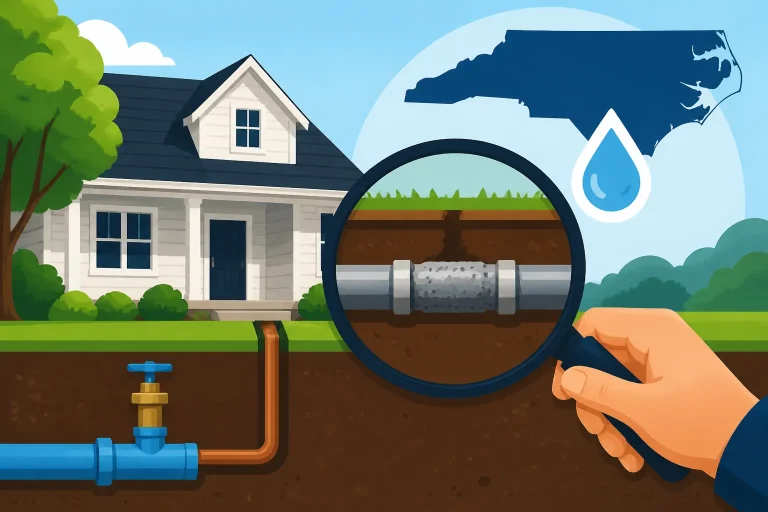
A system report may offer useful background about the water supplied to the service area. But a home’s plumbing can introduce its own questions, including issues related to older pipes or fixtures. A system-wide report cannot settle every question about water after it enters a home. If your concern involves lead, for example, a clean-looking utility report does not automatically answer whether lead is present at a particular tap. See Lead From Your Own Plumbing: How It Gets Past a Clean NC Water Report for more context.
The report also has a defined time frame. It is a historical summary, not a promise about conditions at a later date. If you are trying to determine whether an advisory or outage is active, look for a current supplier notice. How NC Utilities Announce Boil Water and Pressure Loss Advisories explains why advisory announcements are a separate kind of information from a routine annual report.
A useful way to frame the report is to ask three questions:
- What system does this document describe? Confirm the supplier and system named in it.
- What period does it cover? Read the report’s own description of its data period.
- What specific question am I trying to answer? A system report, a current advisory, a private-well test, and a test at a household tap answer different questions.
If the concern is about a taste, smell, or appearance that began recently, the report may provide background but may not identify the cause at a single home. Contact the water supplier for current system information and ask what steps it recommends for the specific concern. For unusual water at one tap, the article Utility Test Results vs. Your Own Tap: What NC Water Reports Miss explains the difference between system results and what a customer may need to investigate at home.
If the property is on a private well, do not use a nearby utility’s CCR as a substitute for well testing. A private well serves a different source and needs information tied to that well. Testing Private Well Water in North Carolina: A Homeowner’s Guide explains how private-well testing differs from reviewing a public water report.
A CCR is therefore valuable without being all-purpose. It gives customers a structured way to review the system’s reported water-quality information. It can also help you ask better questions. Its usefulness depends on matching the report to the right supplier, reading its period correctly, and recognizing when your question is about something beyond the system-level data.
Turning the report into useful next steps
The goal is not to interpret every table like a technical specialist. It is to use the report to understand the supplier’s information and identify any follow-up that makes sense for your situation. A careful reading usually begins with a specific question rather than a general search for a single word like “safe.”
If you are reviewing a report because you just moved, first establish which system serves the property. Then check that the document is the right one and read the period it covers. If you are comparing reports from more than one supplier, make sure they cover comparable periods and that you understand the different labels and table formats. A difference in presentation does not necessarily mean the underlying systems are directly comparable.
If you have a result you cannot interpret, note the exact term, unit, and context shown in the report. Ask the supplier to explain how it presents that result and what the report’s explanatory language means. Avoid relying on a cropped table or a search result snippet without the report’s notes, because important context may be elsewhere in the document.
A focused set of questions for a supplier might include:
- Does this report cover the system that serves my address?
- Which period does the report summarize?
- How should I interpret this particular table entry and its notes?
- Is there a current notice or update relevant to my concern?
- If my question is about water at a specific tap, what testing or follow-up does the supplier recommend?
The report can also help you decide what not to infer. If it summarizes water-system data, do not treat that as a direct test of your kitchen faucet. If it covers a past reporting period, do not treat it as a current advisory. If the property uses a private well, do not assume the report for a nearby community system describes the well.
Where the report points you toward a term you do not know, use a focused reference rather than guessing. For example, How to Read a North Carolina Water Quality Report can help with report interpretation, while How to Use North Carolina Drinking Water Watch to Look Up Your System is relevant when you need to identify or review public-system information. These tools serve different purposes; neither replaces the report for the system that actually serves your address.
If you have a health question about a possible exposure or a specific water result, ask your local health department or a medical professional. A CCR is a public-information document, not individualized medical advice. For questions about a current system condition, contact the supplier through its official website and check its latest notices.
Common misunderstandings about CCRs
“The report says the water is fine, so every tap must be the same”
A CCR is a system-level report, not a separate test of every tap in every building. Water can be affected by plumbing inside a property, so a report cannot rule out every home-specific issue. If the concern is about one faucet, a system report may be relevant background, but it may not answer the question on its own.
“The publication date tells me exactly when the water was tested”
A report’s publication date and the period it summarizes are not necessarily the same. The City of Raleigh describes its CCR as summarizing data from the previous calendar year. Read the report’s own coverage statement rather than treating its publication date as the date of every measurement.
“A detected result automatically means there is a violation”
A reported detection and a violation are different kinds of information. Read the definitions, notes, and explanatory language in the CCR before drawing a conclusion. MCL, Action Level, ND: Decoding the Terms in Your NC Water Report can help with common report terms, but the supplier is the right place to clarify how a particular entry is used in its report.
“A utility CCR tells me whether my private well is safe”
A community water system’s report describes that system’s reported information; it does not test a household’s private well. Well owners need results tied to their own water source and should use appropriate testing and local guidance. The CCR for a nearby system may help explain local context, but it is not a substitute for a well sample.
“An annual report tells me whether an advisory is active now”
A routine CCR is a look-back document, while an advisory is a current operational notice. Check the supplier’s current announcements when you need to know whether an advisory applies. Do not rely on an older annual report to answer a time-sensitive question.
Frequently Asked Questions
Is a Consumer Confidence Report the same as a water test at my home?
No. A CCR summarizes information about the community water system and reporting period it covers. It is not, by itself, a test of a specific home’s faucet or plumbing.
How often is a CCR published?
According to the City of Raleigh, a Consumer Confidence Report is published annually as required by the Safe Drinking Water Act.
Which year of water quality does a report describe?
According to the City of Raleigh, its CCR summarizes data from the previous calendar year. Check each report’s own coverage statement. Charlotte Water’s 2025 report, for example, describes last year’s water quality.
Where can I find a North Carolina CCR?
Check the water supplier’s official website and the North Carolina Department of Environmental Quality page, which links to Consumer Confidence Reports. Confirm that the report names the system serving your address.
Does a CCR cover a private well?
A community system’s CCR does not test an individual private well. If your home uses a private well, look for testing information specific to that well and consult the appropriate local guidance.
Sources
- Charlotte Water — Water Quality Reports Charlotte Water (checked November 13, 2026)
- City of Raleigh (checked May 11, 2026)
- North Carolina Department of Environmental Quality — Public Water Supply Section Forms, Reports & Publications | NC DEQ (checked November 13, 2026)
- Charlotte Water — Current Consumer Confidence Report (PDF) (checked November 13, 2026)
Disclaimer
This article is for general informational purposes only and does not constitute professional advice. Laws, prices and regulations vary by location and change over time. Consult a qualified professional for guidance on your specific situation. North Carolina Water Guide is not a government agency or water utility and is not affiliated with any public water system.