How to Check Whether Your North Carolina Home Has a Lead Service Line
A home can have a lead service line even when its water looks clear and tastes normal, and a utility report may not tell you exactly what is under your yard. The most useful starting point is your water provider’s service line inventory, followed by a careful check of what the inventory covers and, if needed, confirmation from the provider. Here’s how to work through those steps without mistaking an unknown result for a confirmed answer.
What a service line is and why its material matters
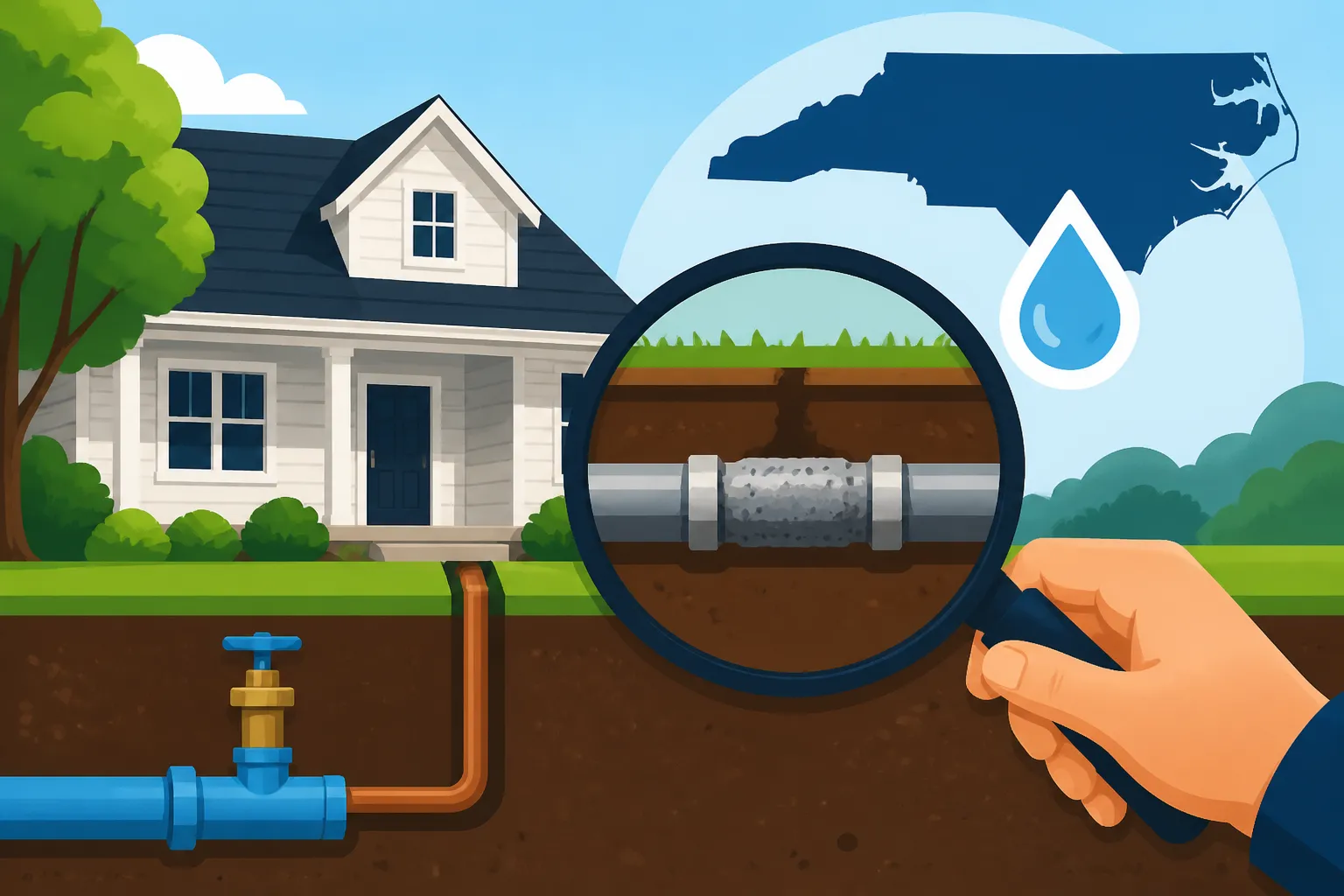
A service line is the connection between the public water main and a home or business. The North Carolina Department of Environmental Quality describes it as “The water line that connects a home or business to the main water line on the street.” It is separate from the plumbing inside the building, such as pipes in walls, fixtures, and the line connecting a water heater.
That distinction matters because there can be more than one material in the route from the water main to a tap. A service line may have a public-system-owned portion and a customer-owned portion, while the building has its own separate plumbing. Finding out the material on one part does not automatically identify the material on the other.
The words “service line” can also be used differently in everyday conversation. A homeowner might call the pipe entering the basement or crawl space the service line, while a utility’s records may cover a longer connection from the main in the street to the building. When asking about your home, clarify whether the answer describes the utility side, the customer side, or the entire connection.
Lead is a concern because it can enter water through lead-containing plumbing. A service line is one possible source, but it is not the only one. Lead can also be associated with other plumbing in a building, such as a lead-containing fixture or older pipe materials. That means a home can have a lead-related water concern even if its service line is confirmed as non-lead.
A water quality report is useful for understanding results from a water system, but it does not necessarily identify every pipe or plumbing material in an individual home. For the difference between system-level results and conditions at a household tap, see Lead From Your Own Plumbing: How It Gets Past a Clean NC Water Report and How to Read a North Carolina Water Quality Report.
If your home is served by a private well rather than a public water system, a public system’s service line inventory may not describe the well plumbing at your property. The relevant questions and responsibilities can differ. See On a Private Well in NC? Whether Service Line Inventory Rules Apply for how that situation differs.
What a service line inventory is designed to show
A service line inventory is a record of the materials identified, or not yet identified, in the service line connections covered by a water system. It is a practical place to begin because the water provider may have records about the service connection that a homeowner cannot see from inside the house.
According to the North Carolina Department of Environmental Quality, community water systems and non-transient non-community water systems must inventory “All service line connections, both system-owned and customer-owned.” The inventory must identify the “potential presence of lead within each service line connection.” In other words, the review is not meant to stop at the portion of the line owned by the water system; it also covers customer-owned connections.
The inventory is not the same thing as a test of water at your kitchen tap. It records information about service line materials, not a lab result showing the amount of lead in a particular glass of water. A line identified as non-lead does not by itself establish that every part of a home’s plumbing is free of lead. Likewise, an unknown material entry does not prove that the line is lead.
This difference can be easy to miss when searching a utility dashboard. A map marker or status label is an inventory result, not necessarily a direct examination of all plumbing between the main and the faucet. If your provider’s dashboard does not make the scope clear, ask what portion of the connection the status refers to and what records support it.
For more on the coverage and requirements behind these inventories, see Which NC Water Systems Must Inventory Service Lines on Both Sides? and What a North Carolina Service Line Inventory Has to Include.
Inventory terms and display styles can vary. A dashboard might show a material category, a location, an address search result, or a notice that records are incomplete. Read the description or legend before treating a label as a final answer. If a map seems to show a single status for the property, confirm whether that status applies to both sides of the service connection.
| Inventory result | What it can tell you | What to clarify next |
|---|---|---|
| Lead identified | The inventory records lead as present for the portion or connection described. | Ask whether the entry covers both the system-owned and customer-owned portions, and what action the provider recommends. |
| Non-lead material identified | The inventory records a material other than lead for the portion described. | Confirm whether both sides were identified and remember that building plumbing is a separate question. |
| Unknown or undetermined | The material has not been confirmed in the record shown. | Ask what information is missing and how the provider can verify the material. |
| Different materials shown for each side | The connection may contain more than one material or have separate recorded statuses. | Ask for a clear explanation of where each portion begins and ends. |
| No result for the address | The address may be listed differently, not included in that search, or not displayed in the format you tried. | Contact the water provider and ask how to locate the property’s record. |
The table is a way to organize questions, not a universal interpretation of every system’s labels. A provider’s inventory legend and explanation should take precedence over assumptions based on a label alone.
Find your provider’s inventory and check the address
Start by confirming which water provider serves the property. A home’s mailing address, city name, or neighborhood does not always tell you which utility maintains the connection. If you need help identifying the provider, use How to Find Out Who Supplies the Water at Your North Carolina Address.
Once you know the provider, look for its service line inventory or address-search dashboard on its official website. The Lead and Copper Rule Revision required public water systems to make an Initial Service Line Inventory dashboard “Publicly available and searchable online,” according to the City of Greensboro. Providers may organize that information differently, so search for terms such as “service line inventory,” “lead service line,” or “lead pipe” on the official provider website.
You may also find a dashboard by searching for the provider’s name together with “service line inventory.” Be careful to use the provider’s official website rather than relying on an old map, a copied list, or a search result that does not identify where its data came from. A utility page can point you to the current inventory and explain how to report an address that does not appear.
Enter the property address as the dashboard requests it. If the search returns no match, try a common variation of the address, such as omitting an apartment or unit designation if the search tool allows it. Do not assume that a missing result means the line is non-lead. The address could be recorded under a different format, the tool might not support the address as entered, or the record might require help from the provider to locate.
For a step-by-step look at finding an address result, see Looking Up Your Address in a NC Service Line Inventory Dashboard.
When the address appears, record the status and read the accompanying notes. Check whether the entry is for the full connection or for a particular side. Look for a legend that defines the material categories and for any explanation of how the information was determined. If the page has an address-level notice, save the page or take a screenshot for your records, but treat the provider’s current explanation as more important than an isolated map symbol.
If the dashboard shows a nearby property but not yours, do not use the neighbor’s result as a substitute. Homes on the same street can have different service line histories, and neighboring records do not establish the material at your address. Ask the provider how to search the property directly.
If you rent, ask the landlord or property manager for the service line information and contact the water provider if the record remains unclear. A tenant may not control access to all parts of the plumbing, but can still ask what the utility has documented about the service connection. A landlord’s description of a pipe should not be treated as an official inventory result unless the basis for that description is clear.
How to verify what the inventory says
An inventory is a strong starting point, but its usefulness depends on how complete and specific the record is for your property. The next step is to resolve any ambiguity directly with the water provider. Use the contact details on the provider’s official website, since those are the appropriate place to find current ways to ask about an address.
When you contact the provider, have the property address and the dashboard result available. Ask questions that identify both the location and basis of the record:
- Does the result describe the entire service line connection or only one portion?
- Is the system-owned portion identified separately from the customer-owned portion?
- What material is recorded for each side?
- Is any part of the connection still unknown or undetermined?
- What records, inspection, or other information support the material designation?
- If the result is unknown, what process does the provider use to resolve it?
- Does the provider need access to the property, and who should arrange that access?
- How will the provider communicate an updated result?
These questions are useful because a short label may hide an important distinction. “Non-lead,” for example, may describe a portion of the line rather than every pipe from the water main to the faucet. “Unknown” tells you the record is unresolved; it does not tell you whether the material is lead or not.
If the provider refers you to a separate notice or inventory document, read it alongside the dashboard. The dashboard may be designed for quick searches, while a supporting document may explain the categories or how the provider handles records that are incomplete. For questions about what an unknown status means, see Unknown or Unknown-Not-Lead? Confirming a NC Service Line Material.
A homeowner can also check for visible pipe where the service line enters the building, if a section is readily accessible. Keep this as a cautious observation, not a do-it-yourself certification. Do not cut, scrape, sand, or otherwise disturb a pipe to identify it. Do not remove a cover, dig, or open a structure just to look for the line. If the pipe is hidden, painted, corroded, or difficult to distinguish, leave the identification to a qualified person or ask the provider what kind of inspection it accepts.
A visual observation can be useful when discussing the property with the utility, but it may not show the full route. A visible section inside a building cannot establish what is buried outdoors, and the appearance of one part of a connection does not identify another part. If you take a photo of an accessible pipe, share it with the provider only as supporting information and ask whether it can verify the material.
Ownership is another question worth separating from identification. A line can have a system-owned part and a customer-owned part, and the owner of a pipe is not necessarily the same as the person who can identify it from a dashboard. Do not assume that an inventory entry tells you who pays for repair or replacement. For that separate issue, see Who Owns the Service Line in NC, and Who Pays to Replace It?.
What to do when the result is lead, unknown, or unclear
If the inventory identifies lead, ask the water provider to explain exactly what part of the connection is recorded as lead and what the next steps are. Request a clear distinction between the provider-owned portion, the customer-owned portion, and any separate building plumbing. Ask how the provider will communicate updates and what information it recommends you keep.
If only one side is identified as lead, do not assume the other side is non-lead. Ask whether the other portion has been confirmed or remains unknown. A connection can have different materials along its route, so one identified section does not settle the material of the rest.
If the result is unknown, ask what is needed to change the status. The provider may be able to explain whether its records need review, whether an inspection is appropriate, or whether access to a particular area is needed. Do not treat the absence of a confirmed lead entry as proof that lead is absent. At the same time, do not interpret unknown as confirmation that lead is present.
If the dashboard does not return the address, or its result conflicts with a notice you received, contact the provider rather than trying to infer an answer from a nearby property. Give the provider the exact address and describe what the dashboard showed. Ask whether the record is missing, filed under a different address format, or represented in another part of the inventory.
Keep useful records together: a copy of the inventory result, messages from the provider, any inspection notes, and any water test reports. If the property is sold or rented later, organized records can help the next owner or occupant understand what is known and what remains unresolved. If you receive a new notice, compare it with the earlier record and ask what has changed rather than assuming a previous status still applies.
A lead service line is not the only possible source of lead in household plumbing. If the service line is listed as non-lead but you still have questions about plumbing materials or tap-water results, ask the provider what its inventory does and does not cover. You may also need to arrange a test designed to assess water at the relevant tap. A water test and a service line inventory answer different questions: one concerns water sampled from a location, while the other concerns recorded pipe material.
If a household member has health concerns related to possible lead exposure, ask a medical professional or local health department for advice. A service line label alone cannot determine an individual’s health status. For general information about possible lead sources inside a home, see Lead From Your Own Plumbing: How It Gets Past a Clean NC Water Report.
Testing, filters, and planning the next steps
A water sample may help answer whether lead is present in water at the sampled location, but it does not identify the material of a buried service line. A result from one faucet also cannot automatically describe every tap in the building. If testing seems appropriate, ask the water provider or a qualified testing professional what kind of sample fits your question, how it should be collected, and how the result will be interpreted.
Be clear about what you want to know before ordering a test. If the question is “What is the material of the service line?”, a tap-water test does not replace an inventory or material inspection. If the question is “Is lead present in water from this tap?”, a pipe inventory is not a substitute for water sampling. A test can be useful, but only when its purpose and limitations match the decision you need to make.
For more on the difference between testing a home tap and relying on system results, see Utility Test Results vs. Your Own Tap: What NC Water Reports Miss. If you choose a filter while waiting for clarification, check that the specific model is certified for lead reduction and follow its instructions. Confirm that the certification claim matches the concern and the way you plan to use the filter. A filter’s certification is not proof that the service line has been identified or replaced. For details on selecting and checking a product claim, see Lead-Reducing Filters for North Carolina Homes.
Avoid choosing a treatment system based only on a general claim about “lead removal.” Product claims vary, and a filter must be suited to the contaminant and the intended point of use. Check the certification for the exact model, installation, and replacement components, and ask a qualified professional if you are unsure how the claim applies to your water results. No filter should be described as a substitute for resolving an unknown service line record.
If the provider confirms a lead service line, ask what it recommends for the particular property and what information is available about the line’s status. If the provider says replacement or other work is planned, request an explanation of which sections are included and how the work will be coordinated. Do not assume that work on one side automatically includes the customer-owned side. The responsibilities and process can depend on the ownership arrangement and the provider’s program.
If the provider says the line is not lead but your concern is the building’s internal plumbing, ask a separate question about that plumbing. The service line inventory does not, by itself, inventory every pipe, fitting, or fixture inside a home. A home’s age or a clean system-level report should not be used as the sole proof that all household plumbing materials are known. For related information about service line records and how they differ from household plumbing, see Does a NC Service Line Inventory Test Your Tap or Indoor Plumbing?.
The most reliable path is to keep the questions distinct: find the address in the inventory, confirm what parts of the line it describes, resolve unknown entries with the provider, and use a separate water test if you need information about water at a tap. That sequence avoids two common mistakes: treating an unknown record as a confirmed lead line, or treating a non-lead entry as proof that every part of the home’s plumbing has been checked.
Frequently Asked Questions
Does a clear-looking tap mean the service line is not lead?
No. Appearance, taste, and smell do not establish the material of a buried service line. Check the provider’s inventory and ask the provider to clarify any unknown or incomplete result.
Does a non-lead service line result mean the whole home is free of lead plumbing?
No. A service line result describes the connection covered by the inventory. Building plumbing is a separate question, so ask what the inventory includes and consider appropriate testing if you have a concern about water at a tap.
Does a water test tell me whether my service line is lead?
A water test measures the sampled water; it does not identify pipe material. Use the inventory or a suitable inspection to answer the material question, and use sampling when you need information about water at a particular tap.
What should I do if my address is not in the dashboard?
Contact the water provider through its official website and ask how your property is listed. A missing search result is not confirmation that the service line is non-lead.
Who should I ask if I am worried about possible health effects?
Ask a medical professional or your local health department for advice about health concerns. The inventory can help identify the recorded pipe material, but it does not assess an individual’s health.
Sources
- North Carolina Department of Environmental Quality — Lead Service Line Inventory | NC DEQ (checked November 13, 2026)
- City of Greensboro (checked September 1, 2026)
- North Carolina Department of Environmental Quality — Lead Service Line Replacement (LSLR) Funding | NC DEQ (checked November 13, 2026)
Disclaimer
This article is for general informational purposes only and does not constitute professional advice. Laws, prices and regulations vary by location and change over time. Consult a qualified professional for guidance on your specific situation. North Carolina Water Guide is not a government agency or water utility and is not affiliated with any public water system.