How to Read a North Carolina Water Quality Report
A North Carolina water quality report can look technical even when the water is meeting applicable standards. The challenge is separating what was detected from what matters, and understanding which dates, units and limits apply. This guide explains how to find the key information, read the tables, interpret monitoring gaps and follow up when a result or notice raises questions.
Start with the report’s date and purpose
A water quality report is often called a Consumer Confidence Report, or CCR. According to the City of Raleigh, a Consumer Confidence Report is published annually as required by the Safe Drinking Water Act. The EPA requires community water systems to provide customers with a consumer confidence report containing detailed information about drinking water quality during the past year.
That timing matters. The report does not necessarily describe what is coming out of your tap today, and it is not a real-time monitoring screen. According to the City of Raleigh, the report summarizes water quality data from the previous calendar year. Charlotte Water also explains that its 2025 report describes last year’s water quality. The reporting period should be stated near the beginning of the document, so check it before interpreting a result as current.
A report is a summary, not a complete record of every test result at every home. The details may cover the public water system as a whole, a treatment plant, a source, or a group of sampling locations. A reading in the report is therefore not automatically a measurement from your kitchen faucet. If you are trying to understand water at a particular address, first confirm which supplier serves it. How to Find Out Who Supplies the Water at Your North Carolina Address explains how to identify the supplier before you look for its report.
Reports can also vary in layout. A utility might combine explanatory text, source information, contaminant tables and contact details into one document. Another may place monthly summaries or archived reports elsewhere. Don’t assume that a missing detail means the system never tested for it. Look for a reporting-period statement, a table legend and an explanation of monitoring frequency before drawing conclusions.
Use this quick orientation before reading individual results:
- Identify the supplier. A town, county system, private water company or community system may serve an address. The report must match the system providing the water.
- Confirm the reporting period. Note which calendar year or past period the results describe.
- Check the system or facility named. A supplier may operate different treatment facilities or use more than one source.
- Read the table notes. They explain units, abbreviations and whether a value is an average, range, maximum or other summary.
- Look for the contact information and next steps. The utility can clarify its own results and explain whether a newer notice or result is available.
A report can help answer broad questions about system-wide water quality, treatment and monitoring. It cannot, by itself, answer every question about plumbing inside a home, a single faucet or a condition that changed after the report’s sampling period. For that distinction, see Utility Test Results vs. Your Own Tap: What NC Water Reports Miss.
Find the right report and the right supplier
Before interpreting a table, make sure you have the report for the water system that serves the property. North Carolina addresses do not always map neatly to a city name. A home inside a town’s general area might receive water from a different supplier, while a nearby property could use a community well or private well rather than a public utility.
If you have a water bill, the supplier’s name is a useful starting point, but it may not explain the source of the water or whether another provider treats or purchases it. Check the utility’s official website for its current report and any information about service areas. If the correct report is difficult to find, the utility can confirm which system applies to your address. The article City Utility, Community Well or Private Well? Sorting Out a NC Address covers the distinction between common water arrangements.
Once you locate the report, check the title and the system name inside the document. A utility’s website may host reports for multiple facilities, towns or service areas. Make sure the report describes the system connected to your home rather than a similarly named neighbor or a different part of the service area.
If the system blends water from more than one source, the report may describe the combined supply or explain where the sources are used. That can help explain why reports from neighboring communities differ. One Tap, Several Sources: How NC Water Systems Blend Their Supplies looks at how multiple sources can contribute to a single system.
A useful way to keep the report in context is to separate what it tells you from what it does not:
| The report can help you understand | The report may not tell you |
|---|---|
| Which system or supplier the document covers | Whether your exact faucet was sampled |
| Which reporting period the data describes | Whether conditions changed after that period |
| Which listed contaminants were detected or reported | Every substance that could be tested in water |
| How reported results compare with the limits or levels shown in the report | The condition of plumbing inside your home |
| What monitoring information the utility chose to summarize | Whether a current advisory or service notice is active |
When the address is supplied by a private well rather than a community water system, a utility CCR is not a substitute for testing that well. The supplier’s report only applies to the system it covers. For private-well results, see Testing Private Well Water in North Carolina: A Homeowner’s Guide.
Read the table before reacting to a result
The contaminant table is often the part readers turn to first, but it is easy to misread without its headings and notes. Start by scanning the full table rather than looking for a single word or number. Identify the contaminant name, the reported result, the unit, the standard or comparison level, and any explanation of how the value was calculated.
A result may be shown as a range, average, highest reading, or another summary. Those descriptions are not interchangeable. An average summarizes readings over a period; it does not tell you that every sample had that exact value. A range shows variation across the measurements included, but it may not represent every place or moment in the service area. A highest value draws attention to the upper end of reported results, but its meaning depends on the sampling and comparison rules described in the report.
Check the units before comparing values. A number without its unit is incomplete. Reports may use different units for different substances, and a value in one unit cannot be compared directly with a value in another. The table’s footnotes or glossary should explain the units and any conversion or averaging conventions. If that explanation is missing or unclear, ask the utility how to interpret the result rather than guessing.
Next, distinguish a detection from a comparison with a standard. A contaminant can be present in a sample without the reported level exceeding the standard shown in the table. According to Charlotte Water, the presence of contaminants in drinking water does not necessarily indicate that water poses a health risk. That statement is a reminder to read the result in context; it is not a reason to ignore a notice or a result above a listed limit.
A practical reading sequence is:
- Find the contaminant’s name and note the unit beside the result.
- Read the column heading to learn whether the value is an average, range, maximum or other reported measure.
- Locate the comparison level, if the report provides one.
- Read any footnote attached to the result, including notes about averaging, sampling or monitoring frequency.
- Look for a violation or compliance explanation elsewhere in the report.
- If the result is unclear, ask the utility what the value represents and what actions, if any, it has taken.
Do not infer that every listed contaminant was detected. A report may include substances that were monitored or regulated even when the results were not detected or were below a comparison level. The table’s symbols and explanatory notes determine how the utility reports those outcomes. Terms such as “ND,” “MCL” or “action level” have specific uses, so consult the report’s definitions instead of relying on a guess. MCL, Action Level, ND: Decoding the Terms in Your NC Water Report offers a closer look at those terms.
The table is also not a ranking of which systems are “cleanest.” Results reflect the substances monitored, how the data are summarized and the reporting period. Comparing reports requires matching the contaminant, unit, sampling approach and comparison level. A bigger-looking number may not mean a greater concern if the substances or units differ.
Understand limits, detections and health language
A report may place results beside a regulatory limit, an action level or another benchmark. These terms are not necessarily interchangeable. Read the report’s definition of each term and note what the comparison is designed to show. A maximum contaminant level, for example, is not the same thing as a detection threshold, while an action level may involve a different type of assessment. The report’s glossary should explain the terminology it uses.
When a report says a contaminant was detected, that means the monitoring found it according to the method and reporting approach described. Detection alone does not establish that a health-based limit was exceeded. Nor does a result below a listed limit necessarily tell you everything about your own household plumbing or the exact water at a particular tap.
The health language in the report deserves careful attention. Charlotte Water says the presence of contaminants in drinking water does not necessarily indicate that water poses a health risk. It is important to keep both parts of that idea in view: a detection is not automatically proof of harm, but the word “detected” should not be used as a substitute for reading the result, the comparison standard and the utility’s explanation.
If the report describes a limit exceedance, violation or other concern, read the accompanying explanation and any public notice from the utility. Look for the affected system or area, the period covered, the type of result and any recommended actions. An annual report may summarize an event, but the utility’s current notices are the place to check for active instructions. How to Read a North Carolina Water Quality Report is the report-reading reference; for distinctions between water-use instructions, see Do Not Drink vs. Do Not Use: North Carolina Water Orders Compared.
There are several separate questions a reader can ask:
- Was the substance detected, or does the table report a non-detection?
- What period and sampling locations does the result represent?
- Is the result an average, a range or a maximum?
- Which limit or benchmark is shown, and how does the report define it?
- Does the report identify a violation or explain that the system met the relevant requirements?
- Is there a current notice that changes how customers should use the water?
A report’s compliance language should not be mistaken for a guarantee about every tap or every exposure. The report summarizes the water system’s information within its stated scope. For individual health questions about a contaminant, contact a local health department or medical professional rather than trying to make a personal medical judgment from the table.
Some contaminants can also enter water after it leaves the public system, through plumbing or fixtures in a building. A system-wide report cannot diagnose a particular home’s pipes. Lead is a clear example of why the distinction matters: water leaving a treatment plant and water drawn from an older home’s tap are not necessarily the same sample. See Lead From Your Own Plumbing: How It Gets Past a Clean NC Water Report and How to Check Whether Your North Carolina Home Has a Lead Service Line for related steps.
Make sense of monitoring dates and gaps
A report may show a sample date that does not match the year printed on the cover. That is not automatically a mistake. Some monitoring is conducted on a schedule that does not require every substance to be sampled each year. The report’s notes should explain the period represented by a result and whether the reported value comes from current or earlier monitoring.
According to Charlotte Water, the EPA and the State allow some contaminants to be monitored less than once per year when concentrations are not expected to vary significantly from year to year. That means a report can legitimately include a result from a monitoring period earlier than the report’s main reporting year. Check the date and footnote beside the specific contaminant rather than assuming every row reflects samples collected during the same period.
A monitoring gap should not be interpreted on its own as proof that a system stopped testing or that the water changed. It may reflect the schedule allowed for that contaminant. At the same time, a table that does not show a recent result is not a measurement of current conditions. The right question is not simply “Why is there no new number?” but “What monitoring schedule applies, and which period does this result represent?”
For each line that matters to you, look for:
- The date or monitoring period for the reported result.
- Whether the utility reports a single sample or a summary of multiple samples.
- A note explaining reduced monitoring or an earlier sampling period.
- Any statement about a violation or a missed monitoring requirement.
- A newer notice, report or utility update that may supplement the annual summary.
If the table presents a result without a clear date, ask the utility which monitoring period it covers. If a date appears old, ask whether the reduced frequency is expected for that contaminant and whether any newer test results are available. Avoid using the age of a result alone to conclude that water is safe or unsafe.
The same caution applies when comparing results from different years. An increase or decrease can reflect a change in the water, a difference in sampling locations, a different reporting format, or a change in how results are summarized. Confirm that the compared entries use the same units, measurement type and monitoring period. Annual Report vs. Monthly Summary: How NC Utilities Publish Results can help distinguish an annual report from other utility updates.
Use the report to investigate a specific concern
A CCR is a good starting point when water tastes, smells or looks different, but the report may not identify the cause of a change at your home. A system-wide result can help you ask informed questions; it cannot prove that an odd taste or discoloration is coming from a particular source.
First, determine whether the change is limited to your home or also affects nearby properties. Ask neighbors whether they notice the same thing, and check whether the utility has posted a current notice or reported nearby maintenance. If a change affects a wider area, the supplier may be able to explain whether it is related to system operations, a source change or other work. If it occurs only at one tap, household plumbing or a fixture may warrant attention.
Then match the concern to the information you need. A report’s contaminant table may not cover every cause of odor, stain, scale or unusual taste. A noticeable change can have several possible explanations, and appearance or smell alone does not identify a specific contaminant. Do not buy treatment equipment solely because a report lists a substance or because a salesperson interprets a home test for you. Confirm the concern with appropriate testing or the utility before choosing a solution.
For water that has a chlorine-like taste, the utility can explain its disinfection practices and any recent operational changes. For a persistent sulfur or rotten-egg odor, the source might be different depending on whether it occurs in hot water, cold water or both. The report alone may not resolve that question. See Tap Water Smells Like a Pool? Chlorine in NC Water, Explained or Where a Rotten Egg Smell in North Carolina Tap Water Comes From for more focused troubleshooting.
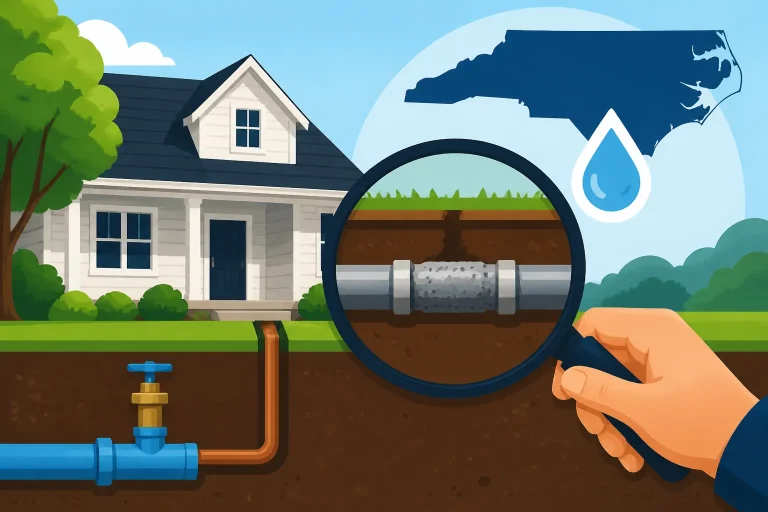
For possible lead concerns, a utility report does not replace information about the service line and indoor plumbing. Check the service-line inventory and ask the utility what its records say about the line serving your address. If the concern involves an individual faucet, ask about sampling options that address the water at that tap. The report can provide context about the system, while an appropriately collected home sample can address a different question. Related reading includes Does a NC Service Line Inventory Test Your Tap or Indoor Plumbing? and One Sample May Miss It: Limits of a Home Lead Test in NC.
If the issue is a possible health concern, do not rely on taste, smell or a broad annual summary to make a medical decision. Contact the utility about system information, a local health department about local public-health guidance, and a medical professional about personal health questions.
Ask better questions and choose the next step
A focused question to the supplier is more likely to get a useful explanation than a general request to interpret the whole report. Have the report open and identify the contaminant, table row, unit, reported value and footnote that prompted your question. Give the address or service area if the utility needs it to identify the correct system.
Useful questions include:
- Which water system or treatment facility does this report cover for my address?
- What reporting period does this result represent?
- Is the value an average, a range, a maximum or another type of summary?
- What unit is used, and what does the table’s comparison level mean?
- Why does this row use a sampling date earlier than the report period?
- Is there a newer report, monitoring result or current notice for this system?
- Does the result apply throughout the service area, or only to a particular source or sampling location?
- Is there a recommended way to test water at an individual home or faucet?
Use the official utility website to locate the current report and contact details. If you are trying to find the correct system, begin with How to Find Out Who Supplies the Water at Your North Carolina Address. If the report is hard to locate, Can’t Find Your NC Utility’s Water Quality Report? How to Request It covers ways to ask for it.
Keep a copy of the report and note what you asked and what the utility explained. If the question concerns an active advisory, use the utility’s current instructions rather than an older annual report. If the question concerns a household sample, make sure the sample is collected and analyzed in a way that answers the question you have. A home test and a CCR do different jobs: the report summarizes system data, while a properly selected home sample can investigate a specific tap or property.
If you are considering a filter or treatment system, start with a clear test result or a well-defined water-quality concern. Check the product’s certification and performance claims against the substance and concentration shown by your own test results. A general claim such as “improves water quality” does not establish that a device is designed to reduce the contaminant you are concerned about. Ask how the equipment is maintained and how you would confirm it is working.
The report is most useful when treated as a map to better questions, not as a verdict about every glass of water. Read the dates and notes, match results to their units and comparison levels, and ask the supplier to explain details that are not clear. If the concern is specific to a home, use home-specific information rather than assuming a system-wide summary describes every tap.
Frequently Asked Questions
Does a contaminant detection mean the water is unsafe?
No. According to Charlotte Water, the presence of contaminants in drinking water does not necessarily indicate that water poses a health risk. Read the result with its units, comparison level, sampling period and report notes. For personal health questions, contact a local health department or medical professional.
Why does a report include a result from an earlier monitoring period?
Some contaminants are monitored less often than annually. According to Charlotte Water, the EPA and the State allow some contaminants to be monitored less than once per year when concentrations are not expected to vary significantly from year to year. Check the specific row’s date and footnotes, and ask the utility if the schedule is unclear.
Does the report show what is coming from my kitchen tap today?
Not necessarily. A report summarizes data for the water system and the period it covers; it may not describe a sample from your home or reflect changes after that period. Ask the utility about current system information and consider a properly selected home test if you need information about a specific tap.
Where can I find the report for my North Carolina address?
Confirm the supplier first, then look for its Consumer Confidence Report on the official utility website. If you are unsure who serves the address or cannot find the document, ask the utility to identify the correct system and provide the current report.
Sources
- Charlotte Water — Water Quality Reports Charlotte Water (checked November 13, 2026)
- City of Raleigh (checked May 11, 2026)
- Charlotte Water — Current Consumer Confidence Report (PDF) (checked November 13, 2026)
Disclaimer
This article is for general informational purposes only and does not constitute professional advice. Laws, prices and regulations vary by location and change over time. Consult a qualified professional for guidance on your specific situation. North Carolina Water Guide is not a government agency or water utility and is not affiliated with any public water system.